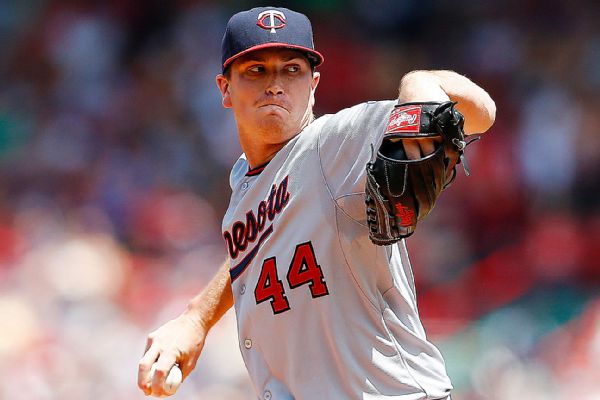
Showing posts with label Kyle Gibson. Show all posts

Wednesday, October 30, 2019

Opening Up the Twins 40 Man Roster


The 2019 Major League Baseball season officially comes to an end tonight as the Washington Nationals and Houston Astros wrap up game seven of the World Series. As the league calendar switches over to 2020 there will be significant roster shuffling. For the Minnesota Twins that already began yesterday, but the front office isn’t close to done when it comes to a 40-man overhaul.

After getting run with the big-league club in September the Twins outrighted a trio of talent off the 40 man yesterday. Outfielders Ian Miller and Ryan LaMarre were jettisoned, and they were joined by utility infielder Ronald Torreyes. With both Byron Buxton and Sean Poppen still on the 60-day IL and needing cleared spots, the Twins effectively have 39 of 40 holes filled. Add in the claiming of Matt Wisler and you’ve got a full boat.

There’s a crop of free agents that will be moving on from Minnesota, and then there’s a handful of arbitration and pre-arbitration guys that decisions will need to be made on. Here’s how they could all turn out:

Free Agents: Jake Odorizzi, Kyle Gibson, Sergio Romo, Jason Castro, Jonathan Schoop

The only name missing from this group is Michael Pineda, who is also set to become a free agent. With his suspension however, he was immediately removed from the 40 man, and would not count against it for any acquiring team until he is reinstated. Gibson is obviously the longest tenured of this group, and it’ll be weird for both the organization and the player to part after a decade together. Despite how it ended, there were some significant high points, and no one could have represented Twins Territory better. Castro split time with Mitch Garver under Rocco Baldelli this season, and if his body will hold up, there’s no reason he shouldn’t be looking for a starting gig somewhere.

Both Schoop and Romo made quick cameos for the Twins. The former was acquired at the trade deadline while the latter was had on a one-year deal. Romo has certain appeal to return as both a good pitcher and strong clubhouse presence, while Schoop would seem to be redundant after the emergence of Luis Arraez.

I'd certainly like to see Minnesota hand Odorizzi a qualifying offer and look to work out a two-year deal. If he's the second or third starting rotation piece they add this offseason, then you'd have to feel pretty good about the group as a whole.

Non-Tender: Sam Dyson, C.J. Cron

Of these two one is a guarantee while the other is far from it. Minnesota dealt for the best reliever at the deadline in Dyson, and instead of a shutdown arm, they got a guy who hid injury (or his former team did) and sapped an asset for nothing. Dyson has one more year of arbitration, and while it would have been great to feel his impact, the only thing Minnesota felt is the bomb he dropped on them after coming here.

What happens to C.J. Cron is largely dependent on how the Twins view Miguel Sano. The former Rays and Angels first basemen had a fine year, and especially so considering the sapped power from his thumb injury. If Sano is moving across the diamond or a better third basemen is a target, then there’s no need to tender Cron at something near $8 million. If he comes back, there’s also nothing wrong with going that route, and assuming the thumb is back to 100%, he’s a good bet to put up even better numbers in 2020.

Decline Option: Martin Perez

There was a time in 2019 when Perez’s option for 2020 looked certain to be picked up, then May 30th happened. Going into that start against the Rays Perez owned a 2.95 ERA and appeared to be the poster child for a Twins influenced fix. He was shelled for six runs in 2.2 IP and owned a 6.29 ERA over his final 21 starts. Left off the Postseason roster the Twins will almost certainly pay the $500k buyout as opposed to the $7.5 million salary next season.

Outright: Trevor Hildenberger, Kohl Stewart

When outrighting a player off the 40-man you’re considering a certain level of opportunity cost. Neither Hildenberger nor Stewart need to go anywhere, but there’s a pretty compelling argument that they both should. Once a pen stalwart for Paul Molitor, Hildy seemed to be ridden into the ground and then left for dead. He came back from Triple-A last year but was every bit as ineffective and has now posted a 6.35 ERA in his last 89.1 major league innings. For a sidearmer that isn’t fooling anyone, it’s simply not going to cut it.

Last season the Twins parted ways with former first round pick Tyler Jay. He never made it to the big leagues, and while Stewart has, this appears to be his time. There’s plenty of better internal options, and Minnesota’s focus this offseason is going to be on pitching. Stewart continued down a path his minor league numbers suggested in that he simply can’t strike anyone out, and the stuff wasn’t good enough to play at the highest level.

Wednesday, October 9, 2019

Decision Making on Parting Twins


With the band-aid now being ripped off and the offseason underway for the Minnesota Twins, no time will be wasted when considering how to reload for the 2020 Major League Baseball season. Rocco Baldelli’s club isn’t going to be an underdog going into the new year, and they should have plenty of momentum built towards a second straight AL Central Division title. When considering who may be on the way out, Derek Falvey has more than a handful of decisions to make.

There’s a very strong group of players that lay the foundation for the Twins core, but we’ve seen where deficiencies may lie, and opportunities exist. With a handful of guys set to take their talents elsewhere, but choice or designation, it will be on the collective decisions made by Minnesota to best position the roster for success. Not every guy with the ability to return should, and it will be in those difficult discussions that the skeleton of the roster is constructed.

Looking at each situation individually, here is what I’d both suggest and think that the Twins will do.

Nelson Cruz: $12MM option in 2020

This picked up today (October 9) and I’d imagine the front office couldn’t have ever been more excited to spend such a sum.
Jake Odorizz: Free Agent

After coaching him to a career season and a debut in the All-Star game, it would make plenty of sense for the Twins to retain his services. A qualifying offer somewhere around $18.5MM could be doled out, but that tends to lean more on draft pick compensation should the player decide to leave. Instead I’d think that Minnesota should make him a long-term part of their rotation and offer him something like $45MM over the next three years.

Kyle Gibson: Free Agent

The former 2009 1st round draft pick will very likely be in another organization for the first time in his career. At 32-years-old it’s the end of an era and will be very different for all parties involved. Dealing with health issues all season didn’t do any favors to Gibson’s performance although he did set a new career best strikeout rate. Unfortunately, a rotation that needs to improve substantially just won’t have room.

Jason Castro- Free Agent

Wrapping up the three year deal he signed with the Twins, Castro’s free agency hits at the same time Mitch Garver has emerged. Jason Caught a career low 79 games in a split opportunity situation this year, but he posted his highest OPS since 2013. Garver should see something closer to 80% of the starts in 2020, but a veteran backup makes a ton of sense. The Twins could ask Jason what his thoughts are on a part time spot, or they could find someone or a similar ilk on the open market. My hunch is that his time here is done.

Jonathan Schoop- Free Agent

A one-year deal following a down season gave Schoop the opportunity to bounce back. He did that even while leaving some to be desired. His .777 OPS was nearly .100 points higher than 2018 but Luis Arraez emerged and took over his starting role. At 28 Schoop should still have a decent market at a down position, and even if his bat isn’t what it was in 2017, his arm keeps him significantly above average at the position. Good find for someone, but not going to be back in Minnesota.

C.J. Cron- Final Year Arbitration

After making just south of $5MM in 2019 Cron is looking at an increase near $6-8MM in 2020. He certainly didn’t finish the year the way he started, but a mangled thumb gave him issues since July. Cron will be only 30 years old and looked the part of a very strong contributor. It doesn’t make a ton of sense to move Miguel Sano to 1B and taking over as a primary DH for Nelson Cruz down the line seems a more logical step anyways. The market isn’t flush with options, and Cron can be had in his final arbitration year as he paves the way for Brent Rooker or Alex Kirilloff to take over. It’s not a guarantee, but I’d expect him back.

Martin Perez- $7.5MM Team Option

There’s no way the Twins are paying Perez nearly double what he made for them this season. Despite a strong start he was a disaster down the stretch and that led to more rotation questions than they hoped to handle. It would make some sense to bring him back at a lesser figure on a one-year pact that can be supplanted by developing arms on the farm. I don’t think the Twins will (or should) prioritize Perez, but he could be a factor depending on how the rest of the starting rotation is addressed.

Sam Dyson- Final Year Arbitration

At the deadline Minnesota added the best arm that was moved in the Giants Dyson. Unfortunately, he came with unannounced red flags and provided less than zero value in his time here. Now having undergone shoulder surgery, Minnesota will likely want no part of his 2020 situation. It’s too bad for the Twins, and at worst a bad look for Dyson. The Giants claim they didn’t know about an injury, and Sam suggests he’d been pitching through it for years. Good riddance to this one, and hopefully some compensation can be recouped through the league.

Sergio Romo- Free Agent

Entering his age 37 season Romo is no longer a spring chicken. Despite his weird knee tendencies, he’s also been a pretty strong beacon of health. Effective once again this season, the Twins should covet his presence in the clubhouse next year. Romo has a great personality and brought a level of excitement to the mound. There’s significant strikeout stuff on the back of a sweeping slider, and fortifying the relief corps a bit further this winter would be ideal.

Monday, October 1, 2018

Twins Developments Worth Watching

There's no denying that the 2018 Minnesota Twins fell short of expectations. This club came into the year having played in the Postseason a season ago, and they were looking to target the Cleveland Indians at the top of the AL Central division. Winning just 78 games, that didn't happen, but there was plenty for this group to hang their hats on.

Obviously a season in which we saw Paul Molitor's squad take a step backwards, there's a few key areas needing improvement. Before getting into those narratives however, we need to take a look at which positive launching points could loom large for the offseason and year ahead.

Kyle Gibson

Mid-way through the 2017 Major League Baseball regular season, it looked as though the former 1st round draft pick would be a non-tender candidate at the end of the year. Then things clicked, and he posted a 3.76 ERA over his final 13 starts. What's only made it look better, is that Gibson has carried the strong performance into 2018.

He wrapped up the year trailing only Jose Berrios in terms of fWAR among Twins pitchers, and his 3.62 ERA was easily a career best. The FIP and xFIP numbers suggest there's some room for regression, but it isn't too worrisome. Another key development is that Gibson showed a heightened ability to get batters out on his own. With a career high 8.2 K/9, his strikeout numbers were notable for the first time in his career. Thanks to the emergence of Gibson, and presence of both Berrios and Jake Odorizzi, the Twins rotation is in a good place.

Jake Cave

In baseball, you are rarely afforded multiple significant opportunities to make an impact. After being pulled from the Yankees glut of outfielders, the Twins afforded Cave an opportunity and he ran with it. As a 25 year-old rookie, he's a bit past the typical prospect shine. That said, he posted a more than enticing .797 OPS and showed plenty of power potential.

Right now, he's locked in as nothing lower than the 4th outfielder for the Twins going into 2019. Cave took the run likely tabbed for Zack Granite coming into the season, and he could very well push Robbie Grossman out of the organization as well. If there's an area to focus on when it comes to development, it's easily plate discipline. A 102/18 K/BB ratio leaves plenty of room for a higher level of on-base prowess to rear its head.

Taylor Rogers

Losing a bullpen piece like Ryan Pressly was going to create opportunity for another arm to step up, and Rogers did in a big way. Leading the Twins in fWAR out of the pen, Taylor posted a career best 2.63 ERA. It was the third straight season in which he's lowered his ERA, and he finished with a career best 9.9 K/9. Although velocity isn't his game, he gets pitches by batters, and doesn't give up free passes.

On top of being dominant as a whole, Rogers wasn't simply a LOOGY either. Sure, he nuked lefties to the tune of a .428 OPS, but he only allowed righties to post a .643 OPS against him in the process. Across over 68 innings this season, he only allowed three longballs, and he pitched his way to the back of the Minnesota pen.

Eddie Rosario

Spanning the group of exciting prospects that rose the Twins ranks together, it's probably a bit surprising that Rosario has emerged the most. That said, we're absolutely at that point in their collective development. After an .836 OPS season in 2017, Rosario solidified his ability by performing at an All-Star level in 2018.

From where I sit, I don't think there's much more to the ceiling of the Minnesota left fielder, but the floor shouldn't be significantly lower either. A guy that has a cannon in the outfield, and can hit as a middle-of-the-order threat, he's going to be a guy that makes sense for a long term extension. Rosario can be a star for the Twins, and that came somewhat out of nowhere.

Wednesday, July 25, 2018

Trade Tea Leaves Telling for Twins

The Minnesota Twins are fully expected to be sellers at this point, and with just under a week until the July 31 trade deadline there's moves to be made. As a few teams have already started to swap assets, the hope would be that Derek Falvey and Thad Levine have taken notice. Specifically, there seems to be real value when dealing controllable pieces and the Twins have two of the best out there.

Today, the Tampa Bay Rays flipped Nathan Eovaldi to the Boston Red Sox for LHP Jalen Beeks. Beeks comes in as the Red Sox 6th best prospect per Baseball America, and Tampa netting him after just 10 starts from Eovaldi post Tommy John surgery seems like some sort of sorcery. At 28, Eovaldi has always been a guy to push the radar gun. He's sitting at 97.4 mph on his fastball this year, and appears to have regained his pre-surgery form just fine. The 4.26 ERA is backed by a 4.28 FIP while his 8.4 K/9 and 1.3 BB/9 are plenty solid. If this is the return Eovaldi commands though, what could Minnesota get for Kyle Gibson?

Still arbitration eligible for another season, Gibson doesn't hit the open market until 2020. Eovaldi checks in as a rental, and will only be with Boston for the remainder of 2018. After coming on strong in the second half of 2017, Gibson has continued to prove that he's truly turned a corner. With a 3.57 ERA and a 3.85 FIP in 2018 the former first round pick has been nothing short of a solid arm. He's also amped up his strikeout rate, posting a career best 8.9 K/9 mark while staying on pace with career norms in the walks department.

It's fair to wonder whether or not the Twins should hang onto Gibson given the likelihood that they turn things around in 2019. Despite having decent pitching depth, Minnesota would be just fine penciling the former Missouri Tiger into the top half of the rotation next season. Ideally this club is making a postseason push in 2019, and getting another strong performance out of Gibson could be integral to that taking place.

The Mets would have the two best arms on the market if either deGrom or Syndergaard were made available. I can't see either of them being moved however, and that means other organizations have an opportunity. If Falvey and Levine are fielding calls on Gibson, a significant haul doesn't appear to be out of the question.

In the bullpen, Minnesota finds another premiere asset. Ryan Pressly has been one of the best relievers in all of baseball this season. He owns a 3.45 ERA with a 2.99 FIP. Jumping up his strikeout total each season, he's at a career best 13.0 K/9 in 2018. That mark puts him 9th among MLB relievers, and above guys like Brad Hand, Felipe Vasquez, and Sean Doolittle.

Much like Gibson, there could be little incentive for Minnesota to deal Pressly. The former Rule 5 pick has another year of arbitration eligibility and also hits the market in 2020. A focus this offseason was to revamp the bullpen, and removing Ryan from it would hurt big time. That said, Jon Morosi recently reported that the Marlins told Boston neither Jay Groome or Michael Chavis along would be enough to acquire their reliever Drew Steckenrider. While Steckenrider has more team control than that of Pressly, they're very comparable pitchers.

At the end of the day I'd be relatively surprised if either Pressly or Gibson was moved. Given the expectation to compete next season, having both of those players on the roster would be beneficial. Moving assets like Brian Dozier and Eduardo Escobar makes much more sense, and should be the focal point of the next few days. Then again if a team comes calling on Gibson or Pressly, ask for the farm and remain grounded in that.

Wednesday, May 30, 2018

Twins Pitching Excellence but Needing More

The Minnesota Twins dropped their 8th game in walkoff fashion while playing the Kansas City Royals deep into the May 29th evening. Accomplishing that feat means they've surpassed the mark set in each of the previous 13 seasons, and 43 of their 58 in franchise history. While walkoff scenarios can sometimes be a fluke, there's a systemic trend that has Minnesota in the dire position they now face. The pitching is there, but the offense has been nonexistent.

Going into the year, Derek Falvey and Thad Levine were vocal about retooling a pitching staff that needed a lift. Despite a successful 2017 campaign, it was clear that Paul Molitor's offense couldn't continue to bail out the pitching staff. Using a franchise record number of starters as well as arms in total, the quality level needed to be increased in order to reduce the quantity. Now nearly through May, it's fair to say that much has been accomplished.

Kyle Gibson and Jose Berrios lead the club in terms of fWAR with tallies of 1.4. Each pitcher has put up a clunker or two, but the vast majority of their outings have been very strong. Gibson has picked up where he left off down the stretch and expanded upon it. Now a strikeout pitcher, he's missing bats and keeping the ball in the yard. Jose Berrios has shown a better level of control, which has led to a walk rate nearly halved from a season ago.

Even beyond the top two starters on the staff, Garvin Alston's group has been plenty good. Jake Odorizzi has served the part of a capable middle-of-the-rotation arm, while Lance Lynn has turned in two recent starts totaling out to a 1.42 ERA. Fernando Romero has burst onto the scene as a potential ace for the future, and the depth down on the farm looks better than ever. To suggest that this is the best Twins rotation in quite some time would be putting it nicely.

Although the bullpen hasn't been quite as sharp, there's a lot to like out there as well. Ryan Pressly looks like one of the best relievers in baseball, while Addison Reed and Fernando Rodney have performed as expected. Zach Duke has been shaky thanks to an uncharacteristic amount of free passes, but the strikeouts have saved him from more trouble. There's room for growth in relief, but the reality is that it's not the significant problem area that the Twins have experienced in the past.

Pitching as a whole has made significant strides within the organization, and it's evident when comparing the club to the league as a whole. Although team ERA checks in at 16th currently (finished 19th in 2017), starter ERA sits at 12th (19th in 2017). Arguably the most impressive boost comes in the form of missing bats, something previous Twins teams simply did not do. In 2018, Minnesota starters have the 9th best K/9 in MLB, and they finished at 26th a season ago.

All of the above represents some very positive developments. The problem however, is that the lineup is doing very little with what they've been handed.

After finishing 7th in runs scored, 10th in extra base hits, and 16th in home runs a season ago, the expectation was for potency from this group. Unfortunately, Minnesota ranks 29th in runs, 29th in home runs, and 19th in extra base hits as of May 30th. Producing at what amounts to a near league worst value, it really doesn't matter what kind of outings Twins pitchers produce.

Through their eight walkoff losses, five of them have come against teams with records at .500 or worse. On the season, Minnesota has played 20% of their first 50 games by scoring one run or less. Simply put, there's way too many guys failing at their jobs up and down the lineup.

Among starters, the Twins have six players with an OPS below .750. Byron Buxton has given Paul Molitor nothing at the plate, while Brian Dozier has decided to slump for a significant period yet again this season. Miguel Sano has dropped off the table when it comes to forcing a fair amount of walks, and Logan Morrison is still attempting to find his footing after a disastrous transition to his new club.

Right now, Eddie Rosario and Max Kepler are the only players providing Minnesota any sort of value in the lineup. Eduardo Escobar's hot streak is long gone, and the bench is made up of a handful of players that really have no business being in the big leagues. What's more dire for the Twins is that answers don't really present themselves outside of the clubhouse. Calling up Nick Gordon could provide a spark, but it would be short lived until Jorge Polanco returns. Chris Carter may provide some thump to the lineup, but he could also be an exact replica of what Sano is currently providing.

At the end of the day, it's on the players currently a part of the 25 man (and more importantly the starting lineup) to get their bats going. While veteran leadership off the field is great, there's no better way to lead than by producing while it matters. Sano, Dozier, Buxton, and a handful of others need to get going. The postseason is likely a distant mirage at this point, but turning things around, salvaging something of purpose, and giving the pitching staff much better than they've been afforded are all musts if this collective wants to be taken seriously in the future.

Monday, April 30, 2018

Is the Real Kyle Gibson Standing Up?

The Minnesota Twins are nearly through their first month of baseball in the 2018 season. To say it's been a debacle would be putting things nicely. After an offseason that saw the 25 man roster get substantially better, as well as infused with more depth, the results have been nothing short of underwhelming. With players across the roster performing below expectations, Kyle Gibson has been a very solid bright spot.

A former first round pick for the Twins, Gibson has never lived up to the promise after being selected 22nd overall in the 2009 draft. A college pitcher out of Missouri, the expectation was that he could rise through the system quickly, and be an impact arm at the highest level. The numbers in the minors were acceptable, but probably not as glowing as the Twins brass would've hoped. Then there was Tommy John surgery, and further delays on getting him to the big leagues. Now with five big league seasons under his belt, it's been somewhat of a roller coaster ride.

Gibson's 2nd and 3rd major league seasons (2014/15) had the makings of a guy who could be a rotation fixture. Despite the club's struggles, Gibson was a reliable arm that you gave you something consistent, even if it wasn't top-of-the-rotation stuff. The past two seasons, the former Tigers pitcher has been optioned back to Triple-A, looked like a non-tender candidate, and then turned things back in what has appeared a relatively unpredictable manner.

Going into the 2018 season, the big question mark for Kyle was whether or not his pitching down the stretch for the Twins could be considered a new norm. Over his final 11 starts, he owned a 3.55 ERA and a .720 OPS against. Shrinking the sample to his final eight starts in 2017, Gibson's numbers were even better with a 2.92 ERA and a .684 OPS against. For a guy who seemingly had already developed the book on himself, this was uncharted territory. He had gone from a question mark for the upcoming year, to being a virtual lock in a Twins rotation that would open a season with postseason aspirations for the first time in a long while.

Now five turns through the rotation in 2018, and Gibson has done nothing to dispel the notion that the end of 2017 was for real. He's compiled 27 innings of work and has a 3.33 ERA to show for it. The 10.0 K/9 is a career best, and nearly four strikeouts more than the 6.4 K/9 career average he has to this point. Gibson's 1.259 WHIP is a career low, as are his 6.7 H/9 and 0.3 HR/9 numbers. If there's something to nitpick at, it's the 4.7 BB/9 he's currently conceding, which is definitely a career worst.
So, what do we make of it all? Well, despite being an extremely small sample size, there's clearly something going on here. MLB's Daren Willman pointed out recently that Kyle Gibson's slider is currently producing the most swing and miss results in comparison to any pitch thrown by any other player across the entire league. What's equally as impressive, is that Gibson's curveball comes in third on the list. Looking at his career usage rates, Kyle is deploying his slider and curve at almost identical rates to what he has always done. That suggests that the pitches themselves are not getting batters of balance. There's something else at play here.

When diving into Statcast data on BaseballSavant.com, we can see that Gibson's spin rates have been on an upward trajectory for the past four years. In 2018, through his first 27 innings, he's put up career best marks for both his slider and curveball. You can take a bit deeper dive into the understanding of spin rates with Mike Petriello's piece from 2017 here. It's not that Gibson's numbers are exceptional when compared across all of baseball, but they are noteworthy among starters, and definitely jump off the page in comparison to his previous output. Generating a better pitch quality, while also garnering more movement across the zone is something that has absolutely help the Twins former first round pick.

Thanks to the improvements to his pitch quality, Gibson's results are currently correlating directly with the process. A 70.2% contract rating is the lowest he's ever allowed in his career, and represents and eight percent improvement in that category. He's also getting swinging strikes at a 13.1% clip, which is over a 3% boost on his career average. The best part of all of this, is that things look somewhat sustainable.

Quality of contact ratings (soft/med/hard) are virtually identical to where they were a season ago for Gibson. His 4.2% HR/FB ratio is probably going to rise as it normalizes a bit, but being a sinkerballer, the home run has never been something that's plagued him too heavily. The .275 BABIP is lower than his .328 mark in 2017, and .308 career total, but it isn't completely out of whack either. In fact, Gibson owns a 3.11 FIP number to date, which suggests that his controllable production is even a bit better than what the actual output has dictated.

To step out from behind the numbers, there's a few things that we can say with near certainty. First and foremost, we're dealing with a small 27 inning sample size. There's a possibility that this portion of the season becomes and outlier as opposed to a reflection of change. That being said, we can also determine that two pitches Gibson throws are being tossed across the plate in their best forms of his entire career. At the age of 30, he's developed strong secondary pitches, and pairing that with his sinker has been a very nice development.

I don't expect Gibson to strike out double-digit batters per nine innings over the course of 2018, and thinking he'll walk nearly five per game seems foolish too. There's no doubting that his repertoire boost has worked to his benefit however, and that could be the key that unlocks all of his potential, whatever that may be.

Tuesday, January 2, 2018

Will The Real Kyle Gibson Please Stand Up

Entering the 2018 Major League Baseball season the Minnesota Twins greatest need is starting pitching. Obviously, that is a similar narrative for many teams across the sport, but there's little denying that things line up for the hometown team to make a big splash in the starting rotation. While Jose Berrios and Ervin Santana are locks among the five this year, Paul Molitor will have to quickly find out what Kyle Gibson he has in 2018.

The former 1st round (22nd overall) pick by Minnesota in 2009 has been the focus of many stories wondering if it will ever all come together. Making his big league debut at the age of 25 back in 2013, Gibson now embarks on his 6th MLB season, and will be doing so at the age of 30. He's yet to pitch more than 195 innings in a season, and his career 4.70 ERA speaks of mediocrity in the truest sense of the word. A pitch-to-contact type, Gibson's career 6.2 K/9 and 3.2 BB/9 doesn't leave much to get hyped about, simply showing a level of predictability.

Rewind back to mid-2017 however, and Gibson appeared to buck his own narrative. Despite looking like a non-tender candidate for the early part of the year, the former Mizzou Tiger landed a 2018 arbitration deal that will come in somewhere around $5 million. Now the question is, how did he get there and will it continue?

A year ago, Gibson's first 17 starts for the Twins added up to a 6.29 ERA and a .920 OPS. He was sent down to Triple-A, and was dealt a hard dose of reality. After posting a 5.07 ERA in 2016, the 3.84 ERA from 2015 looked like a distant memory. Then, in a get-right opportunity, Gibson turned things around against the hapless Detroit Tigers on July 22nd. Twirling 7.1 IP of three-run ball, it was the first time since September 13, 2016 that he pitched at least seven innings. From that point on, a period of 12 starts, Gibson owned a 3.57 ERA and allowed opponents to tally just a .699 OPS. The change was drastic, and the sample size was indicative of it being sustainable. Going forward though, can he replicate what drove that success?

First and foremost, Gibson missed significantly more bats. In his first 17 starts from 2017, Gibson generated strikeouts just 14.1% of the time, while walking 10.4% of batters he faced. Those numbers are a far cry from the 22.1% strikeout rate, and 6.2% walk rate posted in the final 12 times on the mound. By getting more batters out on his own, he also increased his strand rate from 68.1% to 79.2%.

Virtually all of Gibson's balls put in play remained comparable by the percentages. He didn't have a drastic change in line drive, ground ball, or fly ball rates. He was able to shave just about 5% off of his HR/FB rate however. The dip in balls leaving the park could potentially be attributed to a slight swing (roughly 4%) of outcomes taken away from hard contact, and added to soft contact. What that also suggests however, is that we dive into the repertoire.

In looking at Gibson's offerings, I think there's a few takeaways to consider. First and foremost, there was a drastic change in regards to how Kyle attacked the strikezone. After predominantly working in the lower half of the zone through his bad stretch, Gibson attacked higher in the zone and on the corners down the stretch. Not being a high velocity pitcher (averaging 92.7 mph on his fastball) forcing the ball up in the zone can help to get it on hitters quicker. Obviously the swing plane changes based upon pitch location, and the added advantage of going up and in suggests Gibson felt more comfortable challenging opposing hitters.

Secondly, there was one pitch that jumped off the page during his success. After using his slider just 14% of the time through his first 1,495 pitches in 2017, the usage jumped over 20% through his final 1,115 pitches on the season. The numbers didn't equate to the career high 22.1% of sliders he threw a year ago (in fact he was at just 17.8% on the season), but it was clearly an offering he felt comfortable going back to. Notably, the slider also became somewhat of an out pitch. Looking at Gibson's pitch types by count courtesy of Baseball Savant, favorable counts saw a significant amount of the sweeping pitch. Despite being more of an afterthought early in the year, the slider generated 5% swinging strikes in the second half (compared to 3% in the first).
Finally, the slight changes allowed Gibson to see a difference in the results of batted balls against him. Launch angle for opposing hitters decreased, while barreled balls fell off a cliff. Gibson was generating slightly more weak contact, and the quality of balls being put into the field of play as a whole had sunk. Likely an indicator of the process as a whole, as opposed to any one single scenario, Gibson was seeing a payoff for his new tactics.

As a whole, it's hard to suggest that 2018 will see a full season of Gibson at his best. While the positive signs were shown down the stretch, none of the changes were revolutionary, and the differences were rather minor in the grand scheme of things. With a new pitching coach in Garvin Alston, maybe Gibson will find even more success with his slider than before. What we don't know, is whether the slight differences translate to sustainability for a 30 year old over the course of 30-plus starts. I do think that there's enough reason to believe Gibson can be more of his 2015 self than he's been each of the past two seasons however, and that would give Minnesota a quality back end option.

Even before adding another high-level arm into the fold, the Twins will have a stable of options to round out the rotation. With youth as a disadvantage, pitchers like Gibson and Phil Hughes will have to put their best foot forward on a nightly basis to set themselves apart. I'm not going to suggest Gibson will live up to his pre-debut hype, but serviceable seems to be a fair bet in 2018.

Tuesday, September 12, 2017

Gibson Keeping Hitters Off Balance With Offspeed

Over the course of the 2017 Major League Baseball season, Kyle Gibson has been demoted to Triple-A, and experienced multiple periods of struggle at the big league level. Right now however, in the midst of a playoff race, he's been among the Twins most consistent starters. Diving deeper into the change, it doesn't appear anything more than a minor tweak was made. The results suggest that it may have made all of the difference.

Forever, Gibson has been noted as a ground ball pitcher. Despite owning just a 50% ground ball rate for much of the year, Gibson is a sinkerballer that has always had more talk of his wormburners than action. That began to change over the course of his last eight starts though, and since July 22nd, the Twins have ran him out every fifth day feeling pretty good.

Prior to July 22, Gibson had made 17 starts for the Twins. He owned a 6.29 ERA and was allowing a .920 OPS against. In that timespan, he'd posted just three quality starts, and was in general, being hit around the yard. On the 356 balls put in play, 25 of them (or 7%) were barreled. Roughly one in five fly balls left the yard, and his 16 homers allowed only helped to inflate already egregious numbers.

Since that point, the Twins former top prospect has made eight starts to the tune of a 3.19 ERA. Allowing just a .682 OPS against, Gibson has tallied four straight quality starts, and hasn't given up more than three earned runs in any of those outings. When allowing contact, with 184 balls in play, he's given up just four barrels (2%). To get that kind of turnaround, essentially halving the numbers, there has to be a monumental shift right? Well, the answer is, not so much.

Looking at Gibson's repertoire before and after July 22nd, not a whole lot has changed. He's still a sinkerballer first, and then turns to his two offspeed offerings. Throwing both a slider and changeup, it's on the heels of those pitches that opposing hitters are kept off balance. What's been integral for Gibson however, is a slight jump in usage for each.

Early in the season, Gibson was throwing his fastball just under 60% of the time, while dishing up sliders about 16% and changeups right around 15%. Fast forward to today, and his last eight starts have him going with the fastball 55% of the time (at a slightly higher velocity), the slider almost 19%, and the changeup 17% of the time. In cutting out some of his fastball usage (and curveball as well), he's been able to throw offspeed pitches forcing batters to stay back.

The results have translated to a hard hit rate down to 32% from 38% earlier in the year, but more importantly, a HR/FB rate cut from 20% to 9.4%. Gibson is generating ground balls 2% more often (53.1%), as well as giving up fly balls 5% less often. While keeping the ball in the yard, and giving his defense an opportunity, he's found success in utilizing one of the Twins greatest assets.

Now, nothing says the Gibson has found a sure fire path to rest on his laurels. Opposing hitters have a BABIP that's only six points lower (.331) during this good stretch. That number still falls within a normal realm across the big leagues, and in general, leaves plenty of room for success to be had. For a guy that has just a 9% SwStr rate as well as a 15.8% strikeout rate, he's always going to need a push for balls in play that resemble routine outs. As the pitch mix continues to morph though, it seems the current structure is something that can work.

Pitching coach Neil Allen is a big believer in the changeup, and there could have been some work done in getting Gibson to use it more often. The 17% usage rate would be the best single season mark since 2015, when he offered the pitch a career high 19.7% of the time. Maybe not so coincidentally, the Twins hurler relied heavily on his changeup and slider that season, en route to a career low 3.84 ERA.

Now five years into his big league career, and 29 years old, Twins fans are probably through with hoping Gibson has found it. All along though, it's seemed like if he could just hone this or that small thing in, effectiveness was sure to follow. As Minnesota eyes the Postseason, a steadying rotation presence was needed, and Gibson has definitely provided that. Only time will tell how effective the current tweaks are, but right now, all parties have to feel very encouraged.

Tuesday, July 25, 2017

When Depth Becomes An Issue

When trying to set up a major league team for success over the course of a 162 game season, depth is something that every organization strives to possess. Sometimes however, depth becomes a clogging glut of similarity, and ends up being a detriment when trying to push the needle. Right now, the Minnesota Twins could find themselves in that category. The revolving door has continued on the mound, and there doesn't appear to be an end in sight.

After making his second start for the Twins, Bartolo Colon was given another opportunity to take a turn. Despite reports that he was mulling retirement, the bigger issue is that the results were less than lackluster. In two turns for Minnesota, Colon has fared poorly the second time through the lineup. He's allowed opposing hitters to go 8-19 with a triple, two home runs, and three RBI. Despite both starts coming against great offenses (Yankees and Dodgers), Colon hasn't shown any ability to be reliable.

The problem for Minnesota, is that the depth behind him provides lackluster alternatives. Kyle Gibson was recently optioned back to Triple-A Rochester. It comes on the heels of seven shutout innings against the Tigers, but is the result of a poor 6.08 ERA on the year. Gibson hasn't taken the assumed steps forward, and while he's flashed ability at times, has struggle more often than not. Right now, he's probably a better option than Colon, but that's arguably splitting hairs.

Going down the line takes Minnesota to Hector Santiago, who's currently on the disabled list. While the severity of his injury isn't known, the reality is that he wasn't good before being placed there. Santiago owns a 5.63 ERA across 14 starts and has given the club consistently poor starts. He'll likely be reinserted into the rotation at some point, unless of course the Twins want to eat his remaining salary and DFA him.

In acquiring Jaime Garcia from the Atlanta Braves, Minnesota gives themselves a realistic fourth option. Being able to pair him with Ervin Santana, Jose Berrios, and Adalberto Mejia, they have another arm that they can count on giving the ball to every fifth day. The problem that continues to remain however, is depth that really provides no solutions. Whether Colon, Gibson, or Santiago is run out there, none of the trio should be given turns at this point. Because depth has essentially boiled down to warm bodies, the Twins don't have much to gain in starts from any of them.

At some point the organization could turn the keys over to the likes of top prospects Stephen Gonsalves or Fernando Romero, but it doesn't appear like that move is on the immediate horizon. Over the course of 2017, the back of the rotation has been handled by giving opportunities to dart throws. Everyone from Adam Wilk to Nick Tepesch has gotten their turn, and the results have been virtually as expected.

It's a pretty big ask for any big league club to have lights out starters even at the bottom of their rotation. Every team needs pitching and that's why it's always overpaid and at a premium. However, for Minnesota, the depth has resulted in a group of guys being cycled through one after another. For a team that's been in the thick of a division race, they've been in a spot where giving up a loss every fifth day is nearly the expectation. At some point, you'd hope that depth has some upside.

While the season wears on into the end of the summer, Minnesota will need to do everything they can to grasp at whatever playoff hopes they may have. Prospects don't always come up and blossom right away, and even the established veteran is far from a guaranteed thing. The Twins have lulled themselves into believing depth is adequate however, when nothing they run out there gives them any better chance to compete. Having depth with some reasonable upside is one thing, but simply putting names on a roster isn't an equivalent scenario.

Tuesday, May 23, 2017

Twins Starting Depth To Be Tested

After being recalled following a two-start stint at Triple-A, Kyle Gibson was back in the Twins rotation. Against the Orioles on May 22, Gibson surrendered six earned runs on seven hits while walking four and striking out five. He got the win (pitcher wins are stupid), but there was a clear picture of a pitcher in over his head. For now, he'll remain in the rotation, but during the game, it was worth wondering what would happen next for Minnesota?

In an ideal world, Stephen Gonsalves, Fernando Romero, and Felix Jorge are all ready to compete at a significant level. That reality isn't one we're living in though. All three are at Double-A, and none are ready to make the jump to Triple-A or the big leagues any time soon. There's still a long term gameplan there, but expecting them to help Minnesota before late summer at the earliest is a fool's errand.

That leads us to upstate New York, and deciding what is available in Rochester. We have seen Nick Tepesch once this season. He lasted just 1.2 IP and while six of the seven runs he surrendered were unearned, it was an uninspiring performance unlikely to challenge big league hitters. If Kyle Gibson isn't the guy, and it's beginning to look like he may need more time figuring it out on the farm, then who is?

Derek Falvey and Thad Levine would likely be tasked with deciding between Aaron Slegers, David Hurlbut, and Jason Wheeler at Rochester. None of them are 40 man players, and of the trio, Slegers is arguably pitching the best this season. While Wheeler has been in big spots previously, and pitched well in 2016, he hasn't gotten off to a great start this season.

Slegers was a 5th round pick back in 2013 out of the University of Indiana. He's now 24 years old, and a relative non-prospect. What he's done however, is put forth a consistent track record at every stop through the Minnesota farm system. His professional ERA stands at 3.57 across 494.2 IP. In 2017, he's totaled a 4.25 ERA over 42.1 IP and rarely issues walks (1.9 BB/9). He's never going to be a high velocity guy, and his career 6.5 K/9 is probably lofty at the next level. While the peripherals aren't flashy, there's reason to believe he's capable.

Thus far, the Twins have used seven starters, and there's a strong likelihood that number trends towards 10 by the time the dust settles. There's nothing more coveted in the game of baseball than starting pitcher, and even moreso, that of the quality variety. It's not fair to assume that every arm called up to the big league rotation is going to be an impact prospect, but if there's a place the Twins organization is starved, it's there.

At multiple points this season, the question as to whether or not Minnesota should deal Ervin Santana has come up. If there's something that highlights the necessity, it could be this. Should the Twins be presented with an offer that returns a solid pitching prospect or two, close to big league ready, there's a lot of appeal there. Right now, this team is much more exciting than many would have imagined, but there's no staying power in the starting pitching.

Over the winter, it makes a lot of sense for the Twins to supplement their offensive youth with an impact starter. There's a few names out there that make sense, and the club has money to spend. If the organization can roll out a rotation that includes a big name or two, along with Jose Berrios and Adalberto Mejia being internal options, they'll be well positioned a year from now.

It may have to be Aaron Slegers in the short term, and if Kyle Gibson continues to struggle, there's no reason not to give him a shot. Pinning your hopes to that level of prospect for the future though, doesn't make a lot of sense. The Twins have some top prospect arms in the system, but they'll need a safety net regardless, and having more impact arms is never going to be a bad thing.

Tuesday, March 28, 2017

A Twins Pitching Triple Hitter

As the spring training slate comes to a close, I couldn't help but find myself wondering about the pitching for the Minnesota Twins. The organization put forth the worst starting ERA in the majors a season ago, and the relief corps wasn't far behind. Going into 2017, it needs to be markedly better, and there's three different storylines I'm keyed in on.

First, let's start with the good. Kyle Gibson has been one of the best storylines for the Minnesota Twins this spring. Across seven starts, he's compiled 28.1 IP worth of work, and owns a 1.59 ERA. Although the sinkerballer has just 19 strikeouts, he's only issued five free passes, and has been incredibly efficient.

Coming off of his worst year as a major leaguer, Gibson has some late breakout appeal. He posted a 3.84 ERA along with a 3.96 FIP in 2015, and there was some real steam behind him being a star performer a season ago. Unfortunately that never got off the ground, and while defense hurt him, he didn't help himself much either.

Although spring numbers can be taken with a very small grain of salt, he's looked like a man on a mission. Gibson has been efficient, calculated, and very, very good. I don't want to suggest that it's because of his Florida performance that causes him to breakout, but a very good outfield should help him, and this could be the year we see Kyle Gibson look like the Twins former top pitching prospect was expected to perform.

Now, somewhere in the middle ground, we find Jose Berrios. Recently he was optioned to Triple-A Rochester. I can understand that he wasn't ramped up after pitching (or not pitching enough) in the World Baseball Classic. However, if he was truly in play for the 5th starter spot, he could have easily been stretched out for 80 pitches by the time his first outing rolled around. The more I thought about the decision, the more frustration I found myself having.

Berrios is headed back to Triple-A again, and he'll be making his 31st start there, as parts of three major stints. For a top pitching prospect that's really blocked by no one, it's a relatively unprecedented move. Minnesota has a hopeful Phil Hughes, and an unnecessary Hector Santiago in their rotation. If the latter ended up bouncing Berrios, that's an unfortunate development.

At some point, the command has to develop for Berrios, and if Minnesota believes he's better off not working with Neil Allen every day, that's probably an indictment of their big league pitching coach. While I can understand the legitimacy of the reasoning behind his optioning, the optics behind it don't look good, and the Twins again decided against giving a high ceiling arm an opportunity.

Rounding out the trio is a situation that absolutely revolves around high ceilings. In the bullpen, I've often suggested the need to be either creative or good. As Minnesota heads north, it doesn't appear their seven relievers will be either of those things. In my last roster projection, I tabbed the group as being Kintzler, Belisle, Pressly, Wimmers, Haley, Breslow, and Rogers. Of that group, you could probably tab Pressly as good, with creative going to Rogers.

Over the offseason, the Twins knew relief pitching was an issue for them. Instead of throwing more money than maybe a player was worth at names like Romo, Holland, Feliz, or any number of others, they settled on one veteran While Matt Belisle has proved serviceable of late, he wasn't going to be near the top of anyone's relief help list. They enlisted Craig Breslow as a veteran who's reinvented himself, but even he was brought in on a minor league deal.

When the dust settled, Minnesota did nothing to greatly improve its pen from outside. Regardless of the fact that veteran relievers can be had easily on one-year deals (and flipped just as easily) Minnesota stood pat. Then they doubled down on the move by suggesting that none of J.T. Chargois, Jake Reed, or Nick Burdi were ready for the big time.

It's absolutely fair to have reservations about those prospects, but if your pen isn't going to be good, giving them run is far from a bad ask. There was really nothing determined this spring that the Twins didn't already know on those prospects either, so the idea that they were on the outside looking in with no real talented veterans above them is a bit disheartening.

At the end of the day, the Twins are going to have to navigate some tough situations on the mound. The rotation remains relatively unchanged, and while Berrios can breathe life into it at some point, Santiago may be sucking it out for a while. Kyle Gibson could be on the verge of a breakthrough, and Paul Molitor desperately needs him to do so. In the pen, the lack of managerial acumen Molitor showed last season, combined with hit or miss arms, Minnesota could be looking at more blown leads than they care to admit to.

Baseball is a game of pitching and hitting, and if you don't have the former, the latter doesn't matter much. The Twins may win one, they're likely going to lose one of these storylines, and well, Jose, it rains...

Monday, March 13, 2017

How To Stop The May Fallout

Having spent time at spring training down in Fort Myers last week, the Twins came off with a process that looked poised to process better results. 2017 has been looking like a season in which Minnesota could turn the page from an ugly 103 loss a season ago. Then, upon returning to Minnesota, the news that Trevor May's season would now be over had hit. What happens now?

After looking back through some of my tweets from Minnesota's exhibition against Team USA, it seems I had been aware of what really was unknown. Sitting around 95 mph on his fastball at the start of the game, May's velocity dipped to 91-92 mph in short order. It was later revealed that in a pitch midway through his outing, he blew out his UCL. Now destined for Tommy John surgery, the Twins must pick up the pieces and ask themselves what's next.

I had Trevor May penciled in as the team's fifth starter. He wasn't going back to the bullpen with his back issues, and he offered legitimate upside in the rotation. While that now isn't going to happen, the list of candidates to take his place is long. Everyone from Jose Berrios, Adalberto Mejia, and Justin Haley to Ryan Vogelsong, Tyler Duffey, and Nick Tepesch should be in play. For Molitor's squad though, I think the narrative is less about the next man up than it is the men already involved.

There has long been little doubt that Phil Hughes, Hector Santiago, or Kyle Gibson would be in the Twins Opening Day rotation. Each of those three was a lock, and they'd be joining Opening Day starter Ervin Santana. What becomes integral now is that the trio elevate themselves to pick up the slack.

First and foremost, Hughes has to show his injury is behind him. Over the course of the spring, a lot had been made of Hughes' velocity, and for good reason. After undergoing Thoracic Outlet surgery, he's seen a visible decline in the speed of his fastball. For a guy that doesn't blow batters away, losing any competitive advantage isn't ideal.

Last season, Hughes turned in just 59 innings before ending his season. He had already given up 11 homers, after surrendering a league worst 29 the season before, and his walk rate had doubled (but still respectable at 2.0 BB/9). Hughes hasn't given Minnesota more than 5.4 K/9 since his incredibly debut season, and he'll need to be better than his low water mark this time around. Minnesota isn't going to bank on him to be that Cy Young type pitcher he was in 2014, but he must have an ERA right under 4.00 and strike out at least six per nine. It's a big ask for a guy with a lot of question marks, but the Twins can't have him do less now.

That brings us to Hector Santiago, who's done little to put himself in good graces since getting to Minnesota. The Twins are paying him virtually the same $12 million that Ricky Nolasco took up, and his numbers haven't been heartwarming. After coming over from Los Angeles last season, Santiago owned a 5.58 ERA and gave up 13 long balls (to total 33 on the year).

The addition of Jason Castro should help Santiago. Kurt Suzuki wasn't going to do him favors behind the dish, and a pitcher who has given up 62 homers since 2015 needs every advantage he can muster. Again, the Twins won't be counting on the 2015 All Star version of the former Angels pitcher, but they need him to pitch like he deserves to be in the rotation as opposed to an arbitration casualty.

Finally, the biggest boost from the group could come from home grown Kyle Gibson. The former first round pick has been a breakout candidate for the past two years now, and it just hasn't come together. After an exciting 2015, Gibson took a big step back in 2016, and that needs to reverse its course. Despite owning a 5.07 ERA last season, it was the 4.70 FIP that did him in. Owning strikeout and walk totals in line with his career norms, Gibson wasn't doing himself any favors with an already shaky defense.

Molitor's sinkerballer needs to put himself in good situations and capitalize on them. Through early spring action, he's arguably looked the best of all Twins starters, and while results aren't much to get hung up on, his process and efficiency have been notable as well. If Gibson can emerge as the ace of the Twins staff, and take the reigns from Ervin Santana, the rotation group will be elevated beyond what the loss of May likely is.

At the end of the day, Minnesota not having Trevor May in the rotation to begin the year is an unfortunate development. No matter who fills his shoes however, it's going to be on the cast of the already assumed starters that will need to pick up the slack. What kind of upside Minnesota's 5th starter possesses was always going to be a wild card, but the margin for error is now markedly smaller.

Time to see who can pick their teammate up.

Monday, December 19, 2016

Where Does The Twins Pitching Come From?

A year after having the worst starting pitching staff in the big leagues, the Minnesota Twins will be looking to turn a significant corner in 2017. Paul Molitor has a pretty realistic opportunity to bounce back greatly in the wins column, but it's only going to happen if he can get productive outings from his starters.

While the Twins haven't had a true ace since the days of Francisco Liriano or Johan Santana, there are plenty of teams the operate with a good group rather than a top heavy individual. The Twins will be taking the latter path this year as they fill out their rotation, but the question becomes exactly who rounds it out.

Going into the year, I count at least 10 pitchers that Minnesota could task with starting a game. After using 11 different starters last season, I opined that the Twins would run out no more than 8 in 2017. Counting Ervin Santana, Hector Santiago, and Kyle Gibson as rotation locks, the club will need to make decisions on the final two spots. That brings us to the candidates and the order of their likeliness:

Phil Hughes

In Hughes, the Twins have an odd scenario. He's absolutely a lock if he's healthy, but coming back from Thoracic Outlet surgery doesn't guarantee that. Guys have bounced back differently, and he could be a shell of himself, or not pitch again at all. Hughes has faded every year since finishing 7th in the Cy Young voting during his first year with the Twins. If he does come back, hoping he lands somewhere just north of his 3.90 ERA across 2014-15 would make Minnesota ecstatic.

Trevor May

I'm much more skeptical than some on whether or not May finds success as a starter. Working as a reliever, he saw a nice spike in both his velocity and strikeout rates. Unfortunately, his back flared up and is likely tied to usage concerns. He hasn't consistently started since his debut season in 2014, and the results weren't good. Now more developed as a professional, the Twins will have to hope he can give them the strikeouts, with better command, and stay healthy.

Jose Berrios

After doing himself few favors last season, Berrios is going to be in a scenario in which he has to earn his spot during Spring Training. If Hughes isn't ready from the get go, I'd bet Berrios is the next man up. Command was the issue during Jose's rookie season, and his flat plane fastball got hit over the fence far too often (12 HR in 58.1 IP). The Twins will need to rely upon the year providing valuable experience, and the dominating stuff from Triple-A playing up a bit more at the highest level.

Adalberto Mejia

Acquired in exchange for Eduardo Nunez last season, Mejia was a nice get for the Twins system. He doesn't have flashy stuff, but should be capable of a back end spot in the rotation. In four starts for Triple-A Rochester, he totaled a 3.76 ERA to go with an 8.5 K/9. At the big league level he surrendered two earned runs across just 2.1 IP as a reliever. Mejia should get a serious look in Spring Training, and he's maybe the safer option if Minnesota wants to make absolutely sure that Berrios is ready.

Stephen Gonsalves

Now we get to the bit of the stretch portion for Opening Day rotation options. Gonsalves is the Twins top pitching prospect by most accounts, and he should be expected to be a solid contributor. However, he's yet to pitch above Double-A. While Gonsalves owned a 2.06 ERA last year, his 10.0 K/9 was watered down a bit by a 3.7 BB/9. He has some command issues to work through, and will need to rely on pitching at the higher levels as opposed to just throwing. I'd expect him to make his MLB debut this season, but not out of the gate.

Tyler Duffey

After starting 36 games for the Twins over his first two big league seasons, it's time Duffey heads to the bullpen. A college closer at Rice, Minnesota went the most sensible route in attempting to convert him to a starter first. Now 26 and without a dominant trio of offerings, he can be a very good two pitch reliever. His curveball is filthy when it's on, and he'll be more than capable of getting big leaguers out. Send him to the pen, decrease the homers (25 in 25 starts during 2016) and enjoy the uptick in velocity and strikeouts.

Justin Haley

Included here because Haley has worked as a starter for the entirety of his minor league career, and likely is slotted there in the Twins future, he should only see pen time this season. Haley did pitch at Triple-A during 2016 and fared well posting a 3.59 ERA. He has been categorized as among the safest Rule 5 picks, and many have said he's major league ready to back-end a rotation. Given what's ahead of him though, I'd welcome his opportunities in 2017 to come in a long relief role.

Tuesday, July 5, 2016

Salvaging The Worst Of The Twins

Through 82 games, the Twins are on pace to blitz by a franchise worst amount of losses, and finish the season as the worst team in history. Suggesting the first half of the season has been anything but a disaster would be putting it nicely. That all being said, there's plenty left to play for in 2016.

Considering that the bulk of Minnesota's schedule to close out the year comes against AL Central foes, Paul Molitor's club will see a lot of their divisional rivals and can begin to prepare for the year ahead. While it's going to be important to try and slow the pace of the losing, it's equally as important to set up for success in the year ahead.

Looking at how the Twins have positioned themselves, what will be available on the market, and where the roster stands, many of the answers for the future are going to need to come from within. Starting to figure those out sooner rather than later remains in the best interests of the club.

If you're going to place a heightened focus on certain places the rest of the way, here's exactly where I'd point you:

1. Jose Berrios

First and foremost, Jose Berrios needs to get back up to the big leagues and settle in. Across his last four Triple-A starts he's owned a 0.60 ERA and allowed opposing hitters to bat just .104/.171/.156 against him. He's allowed just one home run in his last 30 innings and he's walked batters at just a 2.1 BB/9 rate over that time.

There's no denying he scuffled in his big league debut. As Keith Law of ESPN warned, command and a flat fastball were his biggest deterrents. He'll need to keep the ball in the yard, and he can't issue so many free passes. What remains a constant though is that the Twins need Berrios more than he needs to be here. Minnesota doesn't have an ace, and hasn't for a while. The rotation is full of mediocre options performing below their typical high water marks. Berrios may not be among the best pitchers in the major leagues, but he needs to settle in the rest of the way and be viewed as the Twins go to starter to open 2017.

2. Who is your number two?

If Jose Berrios can finish the year in the big leagues, and do it while pitching well, you have to find out what you have behind him. Right now, the Twins need to be looking everywhere to see if they can move Ricky Nolasco or Ervin Santana. The latter seems like he'll have suitors, while the former's market remains up in the air.

Tommy Milone may not be offered arbitration again, and that leaves just Kyle Gibson and Phil Hughes. Gibson was expected to take a step forward this season, but despite not being healthy, has struggled to do so. He turned in a nice effort last time out, but owns a 4.82 ERA through 9 starts and has walked a career worst 3.4 per nine. Hughes is facing an uphill battle in coming back from Thoracic Outlet surgery, and there'll be plenty of question marks there. Someone needs to pitch behind Berrios, and it can't be a group of mediocrity. Minnesota will need a legitimate one-two-punch, but who makes it up is yet to be seen.

3. Is there an actual closer?

As of right now, the Twins should be operating under the belief that the days of Glen Perkins closing baseball games for them is done. His velocity has declined severely, and he'll now be entering 2017 after a shoulder surgery that required his labrum be reattached to his bone. He has a 3.51 ERA over the past two years and has saved 32 games. Without a stellar pre-All Star 2015 bolstering those numbers though, things are much worse.

Brandon Kintzler is currently operating as the Twins closer, but like Kevin Jepsen before him, that's a role he's not really cast for. Paul Molitor needs to see if Trevor May or Ryan Pressly could be a better option for the here and now. Nick Burdi hasn't pitched hardly at all in 2016 due to injury concerns of his own, and the Twins have given a whopping two outs of major league work to J.T. Chargois. Those are the names I'd start with for closers in 2017, you can't go into the year with a question mark at the back end of a mediocre pen.

4. Settle the log jams

Really, the only areas that the Twins need to be concerned in regards to players piling up are at second and third base. Both Brian Dozier and Jorge Polanco should be at the major league level, but there's currently only room for one. Trevor Plouffe and Miguel Sano play the same position, and when both are healthy, that's been an area of concern as well.

It's pretty obvious that the Twins should've traded Plouffe some time ago. His value has probably never been lower than it is now, and a move at this point would be beneficial if only for opening up the roster spot. In regards to Dozier and Polanco, the return for the Twins All Star second basemen should be hefty. Despite entering his 30's, Dozier is a late bloomer and has been one of the most offensively productive two-baggers in the big leagues. I'm really good with trading either, but the return has to be right for both. At the end of 2016 however, only two of these four should realistically be options going forward for Minnesota.

5. Allow Buxton to struggle

I was really happy to see the Twins make the right move in their latest roster shuffles by adding guys back without sending Byron Buxton out. Sure, he's scuffled at the plate, but his defense is already Gold Glove caliber. He's shown the club he can rake at Triple-A, and there's nothing new he's going to learn by heading back there.

Run Buxton out nearly every day and let him struggle through it. He's got a good head on his shoulders, and confidence doesn't appear to be an issue he struggles with. He's hit a better (but still not good) .222/.248/.374 since rejoining the Twins, and his 37% strikeout rate is a far cry from the 53% output he had prior to his demotion. There's going to be a lot more lumps for Buxton to take the rest of the way, but if he can figure things out and take them now, it sets him up to hit the ground running in 2017. Minnesota needs to let that process play out.

When you have played as bad as the Twins have, there's not many positives to draw from the first half of what has been an unfortunate year. That being said, the rest of the way invites an opportunity to position things for a better start in 2017, as opposed to packing it in and slogging through the rest of the schedule. If Minnesota can get a few things to click down the stretch, the team they have a year from now will be significantly better for it.

Wednesday, March 16, 2016

Wednesday From The Fort

On Wednesday, I spent the majority of my day over at the Lee County Sports Complex and Hammond Stadium taking in different aspects of spring training. With the Double and Triple-A teams taking on the Orioles in the early afternoon, as well as the Twins battling the Red Sox at night, there was plenty of action taking place.

Upon arriving for the day, the most necessary definition was to make my way to the back fields. Knowing that the high level minor league teams would be competing at home for the day, I was looking forward to seeing a handful of guys I've developed relationships with over the past year. While I was plenty early and beat most of the players to the field, I posted up in position to take in the Double-A action.

Although the Orioles don't have the minor league farm system that Minnesota does, the Double-A team still has a good amount of talent. Notably, Chance Sisco, one of Baltimore's top prospects, was behind the plate for them. On the Twins side, former first round pick Levi Michael was starting at second next to defensive wizard Engelb Vielma. No doubt the star of the show however was the starting pitcher, Tyler Jay.

Jay, Minnesota's 2015 first round draft pick, warmed up about 30 minutes prior to gamete. I found this interesting as starters are generally out on the field earlier. However, coming from a relief background, it's completely plausible that his routine is significantly shortened. Regardless, he took the mound in the first, and it was up to the Orioles batters to figure them out.

After a rocky start in which Jay threw just 11 of 20 strikes and gave up an earned run, he settled in. Through four complete innings pitched, Jay pumped 38 of 54 pitches for strikes, registered eight of 16 first pitch strikes, struck out five, walked one, and gave up two earned runs. All in all, his first and fourth innings were the only thing keeping him from a rather crisp start. Sitting at 95 virtually from start to finish, the velocity from the lefty is something incredibly enticing now working as a starter.

Hitting was virtually non-existent in the Double-A game. Orioles pitchers had Twins hitters generally grounding into routine outs and not doing much with the ball in play. Jay was really on hit hard in the fourth, and had the Baltimore batters swinging well after the ball was in Joe Maloney's glove prior to that. For a handful of pictures from the game, check out my Twitter account here.

Making the short walk from one field to the other, I caught a brief bit of the Triple-A action as well. Upon viewing that game, Travis Harrison blasted a homer (which caused some fun ribbing from Adam Brett Walker) before Marcus Walden came on to work his final inning. Up in the Twins half of the inning, Stephen Wickens put a charge into a ball just before Shannon Wilkerson launched a mammoth home run to left field. No idea where the game stood at that point, but the Rochester guys were putting the bat on the ball.

I stuck around a bit to watch Jake Reed come on in relief. He had recently been reassigned from big league camp, and I believe this was his first appearance on the minor league side. He hit his first Orioles batter, and then settled in. Reed has flashed some nice stuff, and consistency is going to be the name of the game if he's going to debut for the Twins this year.

For the nightcap, Boston brought a handful of regulars over to Hammond Stadium to face what looked like the Twins "A" lineup. Byron Buxton was scratched late due to being sick, but regulars were all over the rest of the field. With Mookie Betts, Pablo Sandoval, Dustin Pedroia, and Hanley Ramirez all in the Red Sox lineup, Kyle Gibson would have his hands full.

Gibson gave up a solo shot to Betts in the game's first at bat but then settled in nicely. He worked a 1-2-3 second inning getting both Ramirez and Chris Young on stickers. His third inning was another 1-2-3 and featured strikeouts of both Jackie Bradley Jr. and Betts. The Twins got homers from both Brian Dozier and Eddie Rosario putting them up 7-1 in the 6th, which is when it became to call it a night.

Minnesota now leads the Crosstown Cup 3-1 on the season with six games remaining. Knocking off the Red Sox in the 2016 series would even up the All-Time record at 12 a piece. I plan on heading over to Jet Blue to take in the second Twins and Red Sox matchup of the week on Friday.

For more until then, make sure to stay tuned @tlschwerz

Tuesday, March 1, 2016

The Case For The Ace: Who Gets The Nod?

The snow has melted, the season has changed, and the Twins have embarked on Florida. Spring Training is now well underway, and the Twins are set to kick off their slate of games. As the team positions itself for the meaningful contests in April, it's the March matchups that will pave the way. On the mound to set the action off for the Twins will be Phil Hughes. The question is, what does that mean going forward?

Paul Molitor made the announcement that Hughes will be the starter for the Spring Training opener against the Boston Red Sox. While that would seemingly line up for Hughes to have the inside track to be the Twins Opening Day starter, should that end up being the case?

A season ago, Phil Hughes experienced more regression than any other Twins pitcher. After generating Cy Young votes in 2014, Hughes totaled a 4.40 ERA and 4.70 FIP in 2015. He still walked virtually no one (just 0.9 BB/9), but he also struck out significantly less batters (5.4 K/9 after an 8.0 K/9 in 2014). The Achilles Heel to his performance was no doubt the longball however.

In 2015, Hughes led the league in home runs surrendered (29) and in doing so, posted his worst career mark since giving up 35 as a Yankee in 2012. While no doubt the homers weren't a good addition to Hughes' performance, they also could have signified markedly worse numbers. Over 80% of the balls that left the yard against Hughes were of the solo variety, no doubt saving him from numbers that looked even worse.

So, where does that leave Hughes in the year ahead? As a pitcher who generally has alternated solid performance years, 2016 would already line up to be the next strong year. Looking at his numbers though, Hughes also has some reason for optimism.

A year ago, over 13% of the fly balls Hughes gave up left the yard, that mark doubled the 6.2% posted in 2014, and was also higher than his 10% career average. He allowed hitters to make hard contact over 31% of the time, a 4% increase from 2014, and also higher than his career average (29%). If he's going to turn the corner back towards looking like the pitcher Minnesota initially signed, the strikeouts will again take a tick upwards, and Hughes will have more batters off balance.

For the Twins, Hughes turning things around is no doubt a necessity. The competition for the staff ace shouldn't be a one man race in the season ahead however. Regardless of who starts on Opening Day, both Ervin Santana and Kyle Gibson seem to figure into the team's best pitcher in 2016 when the dust settles.

A season ago, Santana was slapped with an 80 game suspension as Spring Training drew to a close. Despite taking him a handful of starts to settle in, Santana was virtually unhittable down the stretch. From August 30 through the end of the season (7 starts) Santana owned a 1.62 ERA and allowed opposing hitters to slash just .209/.275/.294 against him. He struck out 47 in 50.0 IP and allowed just 14 free passes. In that time frame, he also surrendered just one home run, while have two double-digit strikeout performances.

Looking at what's to come for Santana, the Twins no doubt are looking for a repeat of that late-season performance. Despite signing out of the National League, Santana has been an AL pitcher for virtually his whole career. His best ERA was posted in the AL Central with the Royals during the 2013 season, and his strikeout numbers remained on par with his career averages. When all is said and done, Santana should no doubt be among the Twins best.

Then there's Kyle Gibson. Gibson probably presents the most intrigue of the Twins three cemented starters. After taking a step forward in 2015, it's the year ahead that he should be expected to impress even more so. Finishing with an ERA that ranked near the top of the AL (3.84), Gibson also posted career bests in starts (32), innings pitched (194.2), strikeouts (145), WHIP (1.289), H/9 (8.6), and K/9 (6.7). The former Twins first round pick saw the success he was always billed to be capable of.

Now rounding out the trio of the capable big league starters, Gibson can continue to settle into his own upward trajectory. More than either Hughes or Santana, Gibson benefited significantly from the addition of pitching coach Neil Allen. Allen, who's a changeup believer, had Gibson throwing the pitch a career high 19.6% of the time (up from 12.5% in 2014). The effectiveness of Gibson's changeup was no doubt helpful in generating more swings and misses (9.8% was a career high in 2015).

While there's probably not much stock to put into who becomes the Twins ace, or who toes the rubber on Opening Day, the fact is that Minnesota has three starters all capable of pushing the envelope. With Tyler Duffey, Tommy Milone, and Jose Berrios contributing behind them, each member of the core group is capable of being a stopper and getting the job done. For the first time in quite a while, Paul Molitor should have a staff capable of respectable numbers as compared to the rest of the league.

Thursday, January 28, 2016

Kyle Gibson And The Next Step Forward

In 2015, the Minnesota Twins had to know that their pitching staff was going to need some help. Considering that Ervin Santana was going to miss half of the season, and an expected contribution from Ricky Nolasco wasn't realistic, a different arm had to emerge. While Trevor May and Alex Meyer both served as prospect types that could fit the bill, it was another guy who stepped up; Kyle Gibson.

During his second full season at the big league level, the former first-round pick and Missouri Tiger took significant strides forward. He nearly touched 200 innings pitched (194.2), and for stretches, looked to be the ace of the staff. When the dust settled, Gibson's 3.84 ERA ranked 20th among AL starters, and was tops among the Twins staff.

Improvements came virtually across the board for Gibson. He saw new career best marks in strikeouts per nine (6.7), strikeouts as a whole (145), hits per nine (8.6), WHIP (1.289), ERA+ (108), and he tossed his first complete game. What may be even more exciting is that Gibson likely also has some untapped potential. His walk rate actually increased a season ago (3.0 BB/9) and his FIP nearly touched 4.00 (3.96).

Behind the decreases the Gibson experience in year two, a major culprit seems to be the long fly. Surrendering 18 homers in 2015, Gibson saw just about 11.5% of his allowed fly balls leave the park. Despite being a pitcher who relies on ground balls (53.4% in 2015) Gibson gave up more hard contact than in his 2014 campaign (27.3%).

An adjustment period could have also been happening for Gibson. As with all Twins pitchers a season ago, they were getting accustomed to new pitching coach Neil Allen. Allen noted for his changeup expertise, had Gibson make a significant tweak in his repertoire. After previously throwing just about 12% of his pitches as changeups, Kyle threw them nearly 20% of the time a season ago. With his fastball and slider percentages down, Gibson was able to focus more on keeping hitters off balance with his off speed pitch.

It is in that transition that we can attribute some of Gibson's upward trending success when it comes to attacking hitters. In 2015, Gibson posted a career best 35.7% outside-of-the-zone strike percentage. With hitters chasing, he was more able to find himself in pitcher's counts. Attacking early was a plus as well, throwing over 60% of his first pitches as strikes for the first time in his career. In total, the changes equated to hitters swinging and missing on a career best 9.8% of Gibson's pitches (up a full percent from his previous career high).

Although fWAR for pitchers is not the indicator it is for hitters, the number is still a useful qualification of overall effectiveness. Following a 2.5 fWAR a season ago, it's fair to believe that Gibson has a good deal more to offer the Twins. As a late peaking player due to injury, Gibson at 28 should now be entering the bulk of his prime.

Expecting him to make the eventual leap to something like a 3.0-3.5 fWAR pitcher is not out of the realm of possibility. In 2015, just 10 AL pitchers reached that mark. The list include: David Price, Chris Sale, Dallas Keuchel, Corey Kluber, Chris Archer, Jose Quintana, Carlos Carrasco, Collin McHugh, Sonny Gray, and Danny Salazar. Although Gibson may not have the name recognition as most of that group, seeing him break into it is something the Twins could witness, and no doubt it would be for the better.