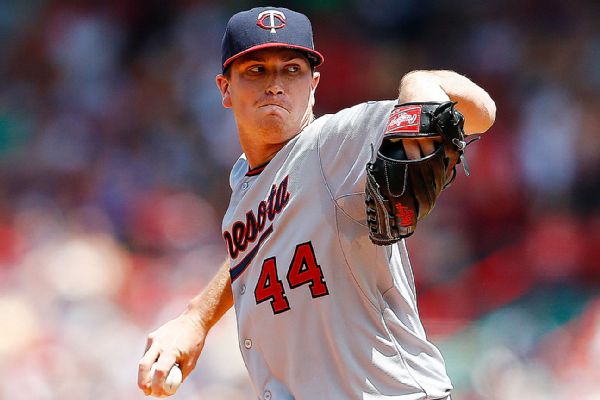
Prior to the news of the Minnesota Twins re-signing veteran reliever Matt Belisle, I had every intention of writing a piece on the curious usage of Matt Magill. Paul Molitor has routinely been lackluster when it comes to bullpen managment during his time as Twins skipper, but things got even more confusing today. After revamping the relief corps going into the season, Thad Levine, Derek Falvey, and Paul Molitor have found a way to make a relative strength into a revolving door.
Needing a fresh arm at the tail end of April, the Twins turned to Matt Magill. Prior to that point, Magill last pitched in the big leagues during the 2016 season. He had just 32 innings under his belt, and at 28 years old, he was a relative flier. Now having been on the 25 man roster for 40 games, he's been used just 13 times in that stretch. Without knowing his numbers, it may not seem egregious given the lack of history to build off of. The numbers though, well they're very good. In 20.2 IP with Minnesota, Magill has posted a 1.31 ERA with a 7.4 K/9 and 1.3 BB/9.
It wouldn't be a terrible thing to Magill to be largely unused if the Twins found themselves avoiding a need to go to their bullpen. However, in that 40 games timeframe he's been with the club, Ryan Pressly has been ran out to the mound 21 times, while Addison Reed has been called upon on 19 occasions. In the 21 games Pressly has appeared in, he has a 6.11 ERA and is allowing an .886 OPS to opposing hitters. Reed's 19 appearances have equaled out to a 3.38 ERA (compared to a 2.57 mark prior), and an .895 OPS against. To say they are running on fumes is an understatement. It being only June makes matters worse.
Then comes the news of Matt Belisle.
Not only is Paul Molitor not using his full relief corps currently, but he's now been given a veteran arm that the worst bullpen in the big leagues (Cleveland) decided to give up on even at Triple-A. Belisle filled in admirably as the Twins closer down the stretch last season, but his fastball velocity has declined to a career worst 90.9 mph. He's also ceded runs in three of eight appearances at the highest level this season. Molitor hasn't given Magill the opportunity to spell his horses despite Matt proving worthy of a chance, now he'll have an arm that should be utilized in a similar vein to Tyler Kinley or Phil Hughes before him.
Sure, there's a value to clubhouse presence, and that will be a notion disseminated freely when referencing Belisle's signing. That's more a cop out than anything however. Addison Reed, Zach Duke, and Fernando Rodney were intended to be the veteran presence brought in over the offseason. All solid clubhouse guys, they effect Belisle has in the matter should be well represented in the doldrums of Target Field. By spinning an odd fit with the clubhouse tag, Minnesota should and does likely alienate more deserving players toiling away at Triple-A.
Tyler Duffey noted frustration when he was recently optioned back to Triple-A. While he's had poor stints with the Twins this year, he was perfect in his recent opportunity and likely deserved better. Most egregious in all of this is none other than Alan Busenitz. Across 24 Triple-A innings thus far, Busenitz owns a 0.38 ERA, 10.5 K/9, and 1.9 BB/9. There's no other way to put it except that it's a massive mistake to have him be wasting bullets in Rochester. No longer a prospect at nearly 28 years old, Busenitz has proven he's well above the Triple-A level, and he should be working his way into a back-end role with the Twins.
The signing of Matt Belisle on its own isn't some terrible decision. Given the factors at play however, it's one that Thad Levine, Derek Falvey, and Paul Molitor should all be questioned for. The bullpen is currently mismanaged, internal options likely provide a higher impact, and a negative message is sent throughout the organization. While the front office deserves to be commended for how they handled the offseason, the roster moves since the games began are puzzling at best.
Showing posts with label Matt Belisle. Show all posts
Tuesday, June 12, 2018
Tuesday, August 8, 2017
Closers By Creation, Twins Making It Work
Rewind back a few years and the Minnesota Twins knew who would be getting the ball in the 9th inning. For a long time, the answer was Eddie Guardado. The man nicknamed "Every Day" passed the torch to Joe Nathan, and it was then turned over to Minnesota native Glen Perkins. In recent years though, Minnesota has needed to get more creative. As they have done so though, it seems they've consistently created closers out of thin air.
In 2015, Kevin Jepsen was Minnesota's answer to Perkins breaking down. Acquired from the Tampa Bay Rays, he racked up 15 saves despite having just five across 315 appearances to that point. Then again, a year later, Brandon Kintzler emerged. The long time Brewers veteran picked up his first save since minor league ball, and he would go on to run off 44 more up until July 2017. Over the course of three years, Minnesota had consistently created closers out of thin air.
Should this tell us anything, it's likely that the narrative be closers are overvalued, and underutilized. The save is a statistic that places more importance on the 9th inning of a ball game, despite their being no evidence that it actually is. Sure, the game comes to a close when a team is winning after the 9th, but the game likely was decided long before that. In having a pitcher designated to get the final three outs, one of your best relievers may have missed the opportunity to get a much more important trio of outs earlier in the contest.
It really doesn't matter whether or not a big league team has a "Proven Closer," and holds even less importance for a team not destined for the Postseason. That being said, the Twins appear on a path to again create an asset and this time it's in the form of Matt Belisle. The question is, are the pieces there to make it work?
Unlike Kintzler before him, Belisle is not a groundball machine, and he tends to miss some bats. The former throws harder than the latter however, and they both leave something to be desired in a high leverage situation. For Belisle though, there's a few things working in his favor.
During 2017, Matt Belisle has racked up strikeouts at a 7.5 K/9 clip. That mark is his best total since 2013, and the third highest total of his career. While he does induce groundballs 43% of the time, Belisle uses a low 90's fastball to generate swings and misses over 10% of the time (for just the second season of his career). He's giving up contact at a career low 78% of the time, and balls are being hit hard a respectable 27% of the time.
The beginning of the season didn't go well for the 37 year-old veteran. Through his first 17.2 IP, he owned an ugly 8.66 ERA and was allowing opposing hitters to post an .833 OPS. His last 27.0 IP however have been a different story. He's posted a 1.67 ERA and opposing batters have posted just a .598 OPS. Suggesting it's been a tale of two seasons is more than fair.
Down the stretch, the Twins will be on the outside of the playoffs looking in. Having been sellers at the deadline, they realize the uphill battle doesn't seem in their favor. With such an ugly run differential, regression should be expected to hit hard. However, with 52 games remaining as of August 8, the club has exactly half of those contests against teams with sub .500 records.
As the summer turns into fall, Matt Belisle should be expected to get most of the Twins save opportunities. He's absolutely the veteran candidate that manager Paul Molitor falls in love with. In closing out games, Belisle is hardly a worse option than either of the previous two created closers. Whether or not anything more than a handful of saves comes out of his work in the 9th remains to be seen, but for now the Twins have again created from within.
Tuesday, March 28, 2017
A Twins Pitching Triple Hitter
As the spring training slate comes to a close, I couldn't help but find myself wondering about the pitching for the Minnesota Twins. The organization put forth the worst starting ERA in the majors a season ago, and the relief corps wasn't far behind. Going into 2017, it needs to be markedly better, and there's three different storylines I'm keyed in on.
First, let's start with the good. Kyle Gibson has been one of the best storylines for the Minnesota Twins this spring. Across seven starts, he's compiled 28.1 IP worth of work, and owns a 1.59 ERA. Although the sinkerballer has just 19 strikeouts, he's only issued five free passes, and has been incredibly efficient.
Coming off of his worst year as a major leaguer, Gibson has some late breakout appeal. He posted a 3.84 ERA along with a 3.96 FIP in 2015, and there was some real steam behind him being a star performer a season ago. Unfortunately that never got off the ground, and while defense hurt him, he didn't help himself much either.
Although spring numbers can be taken with a very small grain of salt, he's looked like a man on a mission. Gibson has been efficient, calculated, and very, very good. I don't want to suggest that it's because of his Florida performance that causes him to breakout, but a very good outfield should help him, and this could be the year we see Kyle Gibson look like the Twins former top pitching prospect was expected to perform.
Now, somewhere in the middle ground, we find Jose Berrios. Recently he was optioned to Triple-A Rochester. I can understand that he wasn't ramped up after pitching (or not pitching enough) in the World Baseball Classic. However, if he was truly in play for the 5th starter spot, he could have easily been stretched out for 80 pitches by the time his first outing rolled around. The more I thought about the decision, the more frustration I found myself having.
Berrios is headed back to Triple-A again, and he'll be making his 31st start there, as parts of three major stints. For a top pitching prospect that's really blocked by no one, it's a relatively unprecedented move. Minnesota has a hopeful Phil Hughes, and an unnecessary Hector Santiago in their rotation. If the latter ended up bouncing Berrios, that's an unfortunate development.
At some point, the command has to develop for Berrios, and if Minnesota believes he's better off not working with Neil Allen every day, that's probably an indictment of their big league pitching coach. While I can understand the legitimacy of the reasoning behind his optioning, the optics behind it don't look good, and the Twins again decided against giving a high ceiling arm an opportunity.
Rounding out the trio is a situation that absolutely revolves around high ceilings. In the bullpen, I've often suggested the need to be either creative or good. As Minnesota heads north, it doesn't appear their seven relievers will be either of those things. In my last roster projection, I tabbed the group as being Kintzler, Belisle, Pressly, Wimmers, Haley, Breslow, and Rogers. Of that group, you could probably tab Pressly as good, with creative going to Rogers.
Over the offseason, the Twins knew relief pitching was an issue for them. Instead of throwing more money than maybe a player was worth at names like Romo, Holland, Feliz, or any number of others, they settled on one veteran While Matt Belisle has proved serviceable of late, he wasn't going to be near the top of anyone's relief help list. They enlisted Craig Breslow as a veteran who's reinvented himself, but even he was brought in on a minor league deal.
When the dust settled, Minnesota did nothing to greatly improve its pen from outside. Regardless of the fact that veteran relievers can be had easily on one-year deals (and flipped just as easily) Minnesota stood pat. Then they doubled down on the move by suggesting that none of J.T. Chargois, Jake Reed, or Nick Burdi were ready for the big time.
It's absolutely fair to have reservations about those prospects, but if your pen isn't going to be good, giving them run is far from a bad ask. There was really nothing determined this spring that the Twins didn't already know on those prospects either, so the idea that they were on the outside looking in with no real talented veterans above them is a bit disheartening.
At the end of the day, the Twins are going to have to navigate some tough situations on the mound. The rotation remains relatively unchanged, and while Berrios can breathe life into it at some point, Santiago may be sucking it out for a while. Kyle Gibson could be on the verge of a breakthrough, and Paul Molitor desperately needs him to do so. In the pen, the lack of managerial acumen Molitor showed last season, combined with hit or miss arms, Minnesota could be looking at more blown leads than they care to admit to.
Baseball is a game of pitching and hitting, and if you don't have the former, the latter doesn't matter much. The Twins may win one, they're likely going to lose one of these storylines, and well, Jose, it rains...
Subscribe to:
Posts (Atom)